|
Techno Finance and Executive Diary |

|
|
Techno Finance and Executive Diary |
|
|
HOME
. : About my blog : .
Name::"CPerformance" . : Todays Quotes : . . : Recent Posts : .
Top Management Tools . : Archives : .
2005-05-15 . : Stock market : .
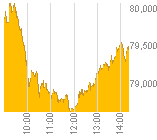
BSE Sensex
|
CNBC Live Telecast . : Finance Daily : .
Economic Times . :All Time Favorites:
Google Games
Hottest Cars-Expensive Houses
Compare your Earnings with Top Shots
. : LABLES : .
|
|||||||||||||||||||||||||||||||||||||||||||||||||||||||
Thursday, November 13, 2008Time value of money- a nice article
 Time value of money Do you remember our three friends - Saver, Borrower and Investor and their tryst with Inflation? Inflation is detrimental to Saver but favourable to Borrower and Investor. But this lop-sided scenario can't last forever. Saver can't always be the 'poor guy'. And Borrower and Investor can't benefit endlessly at his expense. We surely know why. If things continue as they are, then all of us would want to be borrowers and investors! And nobody would bother to save! So, the stage is set for a new character, who would balance the disequilibrium. Enter Interest, the great balancer. Interest tilts the balance in favour of our friend Saver, thereby levelling the playing field for our three friends. But how does he do that? Saver demands interest for postponing his consumption while Borrower and Investor have to pay up Interest for using Saver's surplus. Hence, what Saver loses owing to Inflation, he gains through Interest. Now that we have seen how Interest restores the balance, it is time for us to move on... Assume that your friend calls and offers you Rs10000. He says that you can have it either now or tomorrow. What would you choose? Pretty simple, eh? Your voice is loud and clear as you say, "I want now." So, why did you choose to have the Rs10000 NOW? You obviously are thinking of the many things that you can do with that money. You can buy a couple CDs or a pair of new jeans or even the pair of shoes teasingly displayed at the shoe shop on the way home. After much deliberation, you decide to go for the pair of shoes. With the cash in your pocket, all you need to do now is go to the shop and buy. However, your friend is too busy and is unable to give you the money today, but he promises that you will get it a month later. You are sorely disappointed. All your plans of buying that pair of shoes lie shattered. "Or what if somebody else buys those pair of shoes, which may well be the last such pair on earth?" "Or what if your friend delays his gift by another month?" 'If' - the root of all uncertainties! What we commonly term as 'Risk' and what can ruin all your well laid plans... Hence, if you have a choice, you would rather go to see this friend at his office and collect your money today. Why would you do that? This brings us to a fundamental truth: Time has value. We all know that the value of a rupee does not stay the same across time horizons. Due to Risk and Inflation, a rupee today is worth more than a rupee tomorrow on the time line. In simpler words, we are saying that the value of the same rupee differs at different points of time. This difference in value arises due to the passage of time. Hence, it is called the 'Time Value of Money'. Expressing this in numbers, if you believe that you can buy the same pair of shoes with Rs11000 a month later, then the time value of money for you is Rs1000for a month. Little twist in the tale Now, let us assume that your friend actually turns up and gives you Rs10000. But while on the way to the shoe shop you meet your old classmate who badly needs Rs10000. In that case, will you part with the money? You would, provided he promises to return at least Rs11000a month down the line, so that you can buy the same pair of shoes. (We know that, in real life, you would not take a penny more than what you have lent to your classmate, but just for academic purposes!) So, what do you call this extra payment that you demand over and above the amount you have lent? If the answer is 'Interest', you are right. But then what is Interest? And why is it charged? Let me explain. When you are lending the money to your friend, you forego an opportunity to buy the shoes and use them when you wanted. Hence,you would charge the cost of losing this opportunity, commonly termed as 'Opportunity Cost', to your friend in the form of Interest. One last exercise before we bid goodbye to 'Time Value of money' and 'Opportunity Cost' for now. What is the Opportunity Cost for our friends, Saver, Borrower and Investor? Saver: Saver is a lot like you. He needs to get compensated for the erosion in his purchasing power with time as also the risk associated with postponing consumption. Borrower: Now that Saver has an ace up his sleeves in the form of Interest, Borrower needs to evaluate his decision to borrow and consume now. Why? Now there is interest to contend with. Lost? If your classmate is borrowing Rs10000 from you today to meet his needs and is repaying Rs11000a month later. Then, he is better off fulfilling a need of his that will be worth at least Rs1000more a month later. Investor: Our most enigmatic friend, Investor has several opportunities knocking at his door. He can set up a beer factory or open a restaurant among other things. We could actually exhaust this page writing about the options that he has staring at him. As we all know, our clever friend hopes to maximise his profits and minimise his risks. In case he decides to set up a beer factory, the profits he would have earned by setting up a restaurant are considered as his 'Opportunity Cost'! He also has a very basic 'Opportunity Cost'. He can opt to lend his money to Borrower in return for Interest payment. Thus his investment needs to fetch him enough profits to compensate for all this. Hence, Investor needs to know the value of his future profits in today's terms for all the investment opportunities. Only then can he make the best choice. This brings us to another vital concept: 'Present Value'. source: sharekhan Labels: Business Lessons, Consulting, Excellence, Forgotten Facts, Money Making, Stock Market  
Saturday, September 06, 2008The World's Billionaires #1 Warren Buffett
 Age: 77 Fortune: self made Source: Berkshire Hathaway in United States Net Worth: $62.0 bil Country Of Citizenship: United States Residence: Omaha, Nebraska , United States, North America Industry: Investments Marital Status: widowed, remarried, 3 children Education: University of Nebraska Lincoln, Bachelor of Arts / Science Columbia University, Master of Science America's most beloved investor is now the world's richest man. Soared past friend and bridge partner Bill Gates as shares of Berkshire Hathaway climbed 25% since the middle of last July. Son of Nebraska politician delivered newspapers as a boy. Filed first tax return at age 13, claiming $35 deduction for bicycle. Studied under value investing guru Benjamin Graham at Columbia. Took over textile firm Berkshire Hathaway 1965. Today holding company invested in insurance (Geico, General Re), jewelry (Borsheim's), utilities (MidAmerican Energy), food (Dairy Queen, See's Candies). Also has noncontrolling stakes in Anheuser-Busch, Coca-Cola, Wells Fargo. Insurance operations flourished in 2007. "That party is over. It's a certainty that insurance-industry profit margins, including ours, will fall significantly in 2008." The Oracle of Omaha issued a challenge to members of The Forbes 400 in October; said he would donate $1 million to charity if the collective group of richest Americans would admit they pay less taxes, as a percentage of income, than their secretaries. Had long promised to give away his fortune posthumously. Irrevocably earmarked the majority of his Berkshire shares to charity in 2006, mostly to the Bill & Melinda Gates Foundation. Gift was valued at $31 billion on day of announcement; donation will far exceed that sum so long as Berkshire shares continue to rise. More at: Forbes Millionaires Labels: Forgotten Facts, Money Making, motivation, Stock Market
Thursday, October 04, 2007The Risk of Futures Trading
Most people are naturally risk averse. They don't like to take big risks, especially financial risks. Perhaps you can relate to the point of view of humorist Will Rogers: "I am not as concerned about the return on my money as I am about the return of my money." Futures trading has the reputation of being a highly risky endeavor. It is true that a high percentage of traders eventually lose money. Many people have lost substantial sums. However, futures trading's reputation as a highly risky activity is somewhat undeserved. Think of yourself walking into your favourite gambling casino. You decide to play roulette. The table has a 5 minimum bet and a 5,000 limit, which happens to be your total risk capital. If you place a 5,000 bet on red, you should not be surprised if you immediately lost your 5,000. On the other hand, if you made only 5 bets, you could play for a long time and probably not lose very much at all. Futures trading is the same in the sense that the individual is the one who decides how he wants to operate. He can make large bets or small ones. One can trade futures carefully and risk as little as 1-2% of your trading capital on a single trade. You could trade a long time this way and not lose your entire trading capital. However, most people are not that patient. The unfortunates who lose big are those who can't control themselves. They take big risks and risk a large portion of their trading capital in an attempt to get rich quick. One important quote about trading comes from trading psychology expert Mark Douglas. As he points out, most of us are not as willing to take financial risks as we think: "Most people like to think of themselves as risk takers, but what they really want is a guaranteed outcome with some momentary suspense to make them feel as if the outcome had been in doubt. The momentary suspense adds the thrill factor necessary to keep our lives from getting too boring." Futures trader's should be fully aware of and be comfortable with the risks involved. Managing the risks of trading is a very important part of any trader's success. Although the risks can be managed, they can never be eliminated. Remember that the high returns successful speculators can earn are available only because the speculator is being paid to take risk away from others. Another thing to understand about risk in trading is that you cannot avoid losses by careful planning or brilliant strategy. Numerous losses are part of the process. In The Elements of Successful Trading, Robert Rotella puts it this way: "Trading is a business of making and losing money. Any trade, no matter how well thought out, has a chance of becoming a loser. Many people think the best traders don't lose any money and have only winning trades. This is absolutely not true. The best traders lose a lot of money, but they eventually make even more over time." There is no point trading if you cannot handle the psychological discomfort of making losing trades. While people tend to take losses personally as a sign of failure, good traders shrug them off. The best trading plans result in many losses. Because of the amount of randomness in market price action, such losses are inevitable. Labels: Forgotten Facts, Stock Market
Friday, August 24, 2007TidalFish
more at:http://www.tidalfish.com/ Labels: Forgotten Facts, human resource, Money Making
JustAddMoney.com is an easy way to know exactly how much you have earned, spent, and saved up to the moment
More at :http://www.justaddmoney.com/ Labels: Forgotten Facts, human resource, Money Making
Thursday, August 23, 2007With Pamfax you can send faxes anywhere in the world using Skype credits
More at:http://www.pamfax.biz/ Labels: Forgotten Facts, human resource, Money Making
Wednesday, May 30, 2007Economies Of Scale
Can you identify some of the companies which are expanding like anything!!!..like Re…...sometimes it comes to mind if it is growing like bubble and may eventually get burst. There is some pace which an industry may project and if the future growth is in line with trends already set, gives more confidence on the companies. .Anyways!! There are two types of economies of scale:External economies - the cost per unit depends on the size of the industry, not the firm.Internal economies - the cost per unit depends on size of the individual firm. Economies of scale gives big companies access to a larger market by allowing them to operate with greater geographical reach. For the more traditional (small to medium) companies, however, size does have its limits. After a point, an increase in size (output) actually causes an increase in production costs. This is called "diseconomies of scale". Labels: Forgotten Facts, stories
|