|
Techno Finance and Executive Diary |

|
|
Techno Finance and Executive Diary |
|
|
HOME
. : About my blog : .
Name::"CPerformance" . : Todays Quotes : . . : Recent Posts : .
Top Management Tools . : Archives : .
2005-05-15 . : Stock market : .
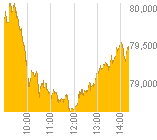
BSE Sensex
|
CNBC Live Telecast . : Finance Daily : .
Economic Times . :All Time Favorites:
Google Games
Hottest Cars-Expensive Houses
Compare your Earnings with Top Shots
. : LABLES : .
|
|||||||||||||||||||||||||||||||||||||||||||||||||||||||||||||||||||||||||||||||||||||||||||||||||||||||||||||||||||||||||||||||||||||||||||||||||||||||||||||||
Saturday, September 06, 2008TOP Celebrity 100
 IT IS THE YEAR OF THE TWEEN. Coming off a concert tour, a hit 3-D movie and a risqué picture in Vanity Fair, pop star Miley Cyrus (a.k.a. Hannah Montana) leads a slew of young stars onto our annual Celebrity 100 ranking of the world's ultrafamous. Also building buzz, and drawing dollars, from the under-18 crowd: Daniel Radcliffe, Zac Efron and Ashley Tisdale. Despite weakening television ratings and magazine circulation, Oprah Winfrey remains at the top of the list, a power ranking based on both earnings and fame. The biggest earner: J.K. Rowling, whose final installment of the wizardly adventures of Harry Potter helped add $300 million to her coffers, solidifying her status as the richest author on the planet. More at TOP Celebrities Forbes Labels: Money Making, motivation, stories  
The World's Billionaires #1 Warren Buffett
 Age: 77 Fortune: self made Source: Berkshire Hathaway in United States Net Worth: $62.0 bil Country Of Citizenship: United States Residence: Omaha, Nebraska , United States, North America Industry: Investments Marital Status: widowed, remarried, 3 children Education: University of Nebraska Lincoln, Bachelor of Arts / Science Columbia University, Master of Science America's most beloved investor is now the world's richest man. Soared past friend and bridge partner Bill Gates as shares of Berkshire Hathaway climbed 25% since the middle of last July. Son of Nebraska politician delivered newspapers as a boy. Filed first tax return at age 13, claiming $35 deduction for bicycle. Studied under value investing guru Benjamin Graham at Columbia. Took over textile firm Berkshire Hathaway 1965. Today holding company invested in insurance (Geico, General Re), jewelry (Borsheim's), utilities (MidAmerican Energy), food (Dairy Queen, See's Candies). Also has noncontrolling stakes in Anheuser-Busch, Coca-Cola, Wells Fargo. Insurance operations flourished in 2007. "That party is over. It's a certainty that insurance-industry profit margins, including ours, will fall significantly in 2008." The Oracle of Omaha issued a challenge to members of The Forbes 400 in October; said he would donate $1 million to charity if the collective group of richest Americans would admit they pay less taxes, as a percentage of income, than their secretaries. Had long promised to give away his fortune posthumously. Irrevocably earmarked the majority of his Berkshire shares to charity in 2006, mostly to the Bill & Melinda Gates Foundation. Gift was valued at $31 billion on day of announcement; donation will far exceed that sum so long as Berkshire shares continue to rise. More at: Forbes Millionaires Labels: Forgotten Facts, Money Making, motivation, Stock Market
Sunday, August 24, 2008Tips for the Entrepreneur
provides several tips for entrepreneurs. Tip 1: Just don't settle. Especially with employees, it is very important to find great people you are compatible with. Tip 2: There is a benefit from being real experts. Experience pays off. Tip 3: Have a healthy disregard for the impossible. Stretch your goals. Tip 4: It is OK to solve a hard problem. Solving hard problems is where you will get the biggest leverage. Tip 5: Don't pay attention to the VC bandwagon. Don't start a company just because you can. Instead, have a really good idea that is good regardless of the funding situation. Labels: Business Lessons, motivation, stories
Tuesday, May 13, 2008Hmm.. That makes sense
Just remove the damn battery from the clock and Enjoy life! 2. Expecting the world to treat u fairly coz u r a good person is like expecting the lion not to attack u coz u r a vegetarian. Think about it. 3. Beauty isn't measured by outer appearance and what clothes we wear, but what we are inside . So, try going out naked tomorrow and see the admiration! 4. Don't walk as if you rule the world, walk as if you don't care who rules the world! That's called Attitude…! Keep on rocking! 5. Every lady hopes that her daughter will marry a better man than she did and is convinced that her son will never find a wife as good as his father did!!! 6. He was a good man. He never smoked, drank had no affair. When he died, the insurance company refused the claim. They said , he who never lived, cannot die! 7. A man threw his wife in a pond of Crocodiles? He's now being harassed by the Animal Rights Activists for being cruel to the Crocodiles! 8. So many options for suicide: Poison, sleeping pills, hanging, jumping from a building, lying on train tracks, but we chose Marriage, slow sure! 9. Only 20 percent boys have brains, rest have girlfriends! 10. All desirable things in life are either illegal, banned, expensive or married to someone else! 11. Laziness is our biggest enemy- Jawaharlal Nehru We should learn to love our enemies- Mahatma Gandhi Ab aap bataaye kiski sune bapu di ya chacha di??? 12. When things go wrong, when sadness fills your heart, When tears flows from your eyes always say these words… Eh Ganpat, chal daru la… 13. 10% of road accidents are due to drunken driving. Which makes it a logical statement that 90% of accidents are due to driving without drinking! Labels: motivation, stories
Saturday, May 03, 2008Its You!!!
 VERY INTERESTING AND THOUGHT PROVOKING One day all the employees reached the office and they saw a big advice on the door on which it was written: "Yesterday the person who has been hindering your growth in this company passed away. We invite you to join the funeral in the room that has been prepared in the gym". In the beginning, they all got sad for the death of one of their colleagues, but after a while they started getting curious to know who was that man who hindered the growth of his colleagues and the company itself. The excitement in the gym was such that security agents were ordered to control the crowd within the room. The more people reached the coffin, the more the excitement heated up. Everyone thought: "Who is this guy who was hindering my progress? Well, at least he died!". One by one the thrilled employees got closer to the coffin, and when they looked inside it they suddenly became speechless. They stood nearby the coffin, shocked and in silence, as if someone had touched the deepest part of their soul. There was a mirror inside the coffin. There was also a sign next to the mirror that said: "There is only one person who is capable to set limits to your growth: it is YOU. You are the only person who can revolutionize your life. You are the only person who can influence your happiness, your realization and your success. You are the only person who can help yourself. Your life does not change when your boss changes, when your friends change, when your parents change, when your partner changes, when your company changes. Your life changes when YOU change, when you go beyond your limiting beliefs, when you realize that you are the only one responsible for your life. "The most important relationship you can have, is the one you have with yourself" Labels: motivation
Wednesday, October 10, 2007How do you feel when you finally see and admit to yourself that you were wrong?
Human systems are chaotic - sensitive to conditions and impossible to predict with certainty. Decisions made in human systems will sometimes fail because: * We did not do the right research * The reactions after the decision was not what you expected * Conditions, that are out of your control, change * The decision was poorly communicated/supported * You/the workplace/the team was not ready for the change in the first place I am most pained by mistakes I make that affect people or that cause a domino affect of negative reactions. But we have to keep swinging (informed swinging) or we will become irrelevant. Great managers make more bad decisions than do mediocre managers. Why? Because great managers approach and get active in more situations. Mediocre managers are more likely to sit back and let others make decisions or let situations linger. Management is not an exact science and on some days it is more art than science. As much as we all hate making bad decisions, it happens to the best and brightest. What's important is the present - what, in this moment, can you do to make the greatest positive difference? How can you learn from mistakes in ways that will benefit your work more than the right decision could have? Labels: Excellence, motivation, stories
Tuesday, September 25, 2007What are the best and worst jobs around?
The criteria Krantz used to determine the best and worst jobs is a bit interesting. For example, he makes assumptions about certain professions and assumes that working inside is better than working outside. He also assumes that working in a non-competitive environment is a plus-point. As for what factors he used to choose the best, he concentrates on income, stress, physical demands, outlook, security and work environment. As such, the list of Krantz' best and worst is rather strange. For example, on his list of the best jobs he has Accountant and Actuary listed first. Parole officer and Statistician also appears on the list of best jobs. The worst jobs list also has some interesting choices. Construction worker tops the list. Dancer also makes an appearance. Cowboy also shows up on the worst list. No sign anywhere of hairdressing – which regularly gets cited as the job which makes people happiest. And probably the first time ever that a survey has made anyone out there who is an accountant or actuary feel better about their career choice. Labels: human resource, motivation
Tuesday, September 18, 20077 Stupid Thinking Errors You Probably Make
The brain isn’t a flawless piece of machinery. Although it is powerful and comes in an easy to carry container, it has it’s weaknesses. A field in psychology which studies these errors, known as biases. Although you can’t upgrade your mental hardware, noticing these biases can clue you into possible mistakes. Which made me consider the significant levels of thinking bias and error in HR processes. The tough part about these biases is that managers and HR practitioners are often unaware of them. Incentive programs are built on faulty assumptions. Training classes are offered without identifying underlying needs. Flawed assumptions tare made abilities. Logic flaws are dangerous in the HR environment. Awareness is the first step toward improvement. So, I took Lifehacker’s list about thinking bias, and overlaid some HR implications. The thinking error labels in bold and the text in italics are from the original Lifehacker article (please go read it in its entirety). The commentary in the text blocks involve HR and people management practices. Confirmation Bias. The confirmation bias is a tendency to seek information to prove, rather than disprove our theories. The problem arises because often, one piece of false evidence can completely invalidate the otherwise supporting factors. HR Implications: When one employee accuses another — of uncooperativeness, lack of attention to detail, aggressiveness or discrimination — there is often confirmation bias present. As they say, “It takes 100 attaboys to make up for one uh-oh.” Very clever Machiavellians in organizations exploit this thinking bias by accusing early and often. Then the accused is on the defensive. And what do we do about this in HR? We look for others to confirm the story rather than looking at the composite of evidence over long periods of time that would argue against the accusation. From a people management standpoint, some look for confirmation that “people don’t work for money” and exclude all evidence to the contrary (like the last 60 people who left because they were underpaid). Hindsight Bias. Known more commonly under “hindsight is 20/20“ this bias causes people to see past results as appearing more probable than they did initially. HR Implications: This is one of those “I just knew he was going to turn out bad” kind of thinking errors. Managers use this one all the time with the “I was able to do it with one hand tied behind my back and you should too” speech. They often forget that a number of forces had to come together to create success. Clustering Illusion. This is the tendency to see patterns where none actually exist. HR Implications: This is about pay and incentive programs. Rewards programs are designed based on controllability, when, in fact, many outcomes can be attributed to purely random occurrences, e.g., the stock market just went up or people started buying more Hush Puppies. A lot of executive pay plans are built around the idea that there are patterns in management decisions that directly affect stock price. It just isn’t so. (Gifted executive compensation designers understand and account for absolute versus relative performance.) Recency Effect. The recency effect is the tendency to give more weight to recent data. HR Implications: In your performance review you’re only as good as your last mistake. When we ask managers to review a year’s worth of performance they often fall prey to the recency effect — they remember more vividly those things that happened in the last month that over 12 months. And reviews suffer for them. Anchoring Bias. Anchoring is a well-known problem with negotiations. The first person to state a number will usually force the other person to give a new number based on the first. HR Implications: The questions most hated by job applicants is “What was your previous salary?” It’s because as soon as the number is thrown out there it becomes the “anchor” for negotiations. Great sales people know this one stone cold. When companies spend three months each year getting employees to document their goals, it turns out that whoever writes down a number first wins. But if an HR manager writes down that a recruiter is going to bring on 300 new hires for the year, that’s the number, even if the previous all-time record in the company was 100. Overconfidence Effect. Studies have shown that people tend to grossly overestimate their abilities and characteristics from where they should. HR Implications: What happens every year at performance review time? Everyone comes in above average, right? There was a recent study (I’m still looking for it) in which something like 80% of managers thought they were well above average in performance. It’s the Lake Wobegon Effect. The same thing happens around pay: Everyone thinks they’re underpaid and should get more. Confidence is one thing; overconfidence as a thinking bias is dangerous. Fundamental Attribution Error. Mistaking personality and character traits for differences caused by situations. HR Implications: We like people who like what we like. When we’re managers, we like people who most resemble us and don’t like people who have different views. And it’s not that we don’t just dislike their ideas, we don’t like them. In a workplace environment that is encouraging more diversity, the fundamental attribution error can be very dangerous Labels: Business Lessons, Excellence, human resource, motivation
Monday, September 17, 2007Do you hate your job?
Do you get the "Monday Morning Blues?" If you truly dread Monday more than any other day, then the work you are doing may not be work you find enjoyable or rewarding. Is Friday the day you long for more than any other? When it comes to time off, who doesn't enjoy it? However, if you spend all of Friday just longing to leave, then maybe your work isn't providing the contentment it should. Enjoy gossiping more than working? If you spend more time chatting about your bosses and co-workers than at your desk getting work done, there might be problems. Other signs include avoiding projects until the very last minute and not ever receiving any kind of recognition from management for projects you do complete. All of these are signposts that maybe the job you are working at is not the job for you. So, what's the solution? Looking for a new job is one. The second is maybe trying to change the job you have. If you used to love your job and now you hate it, maybe it's time to look at what changed. Can it be changed back? Given that humans spend most of their lives working, it only stands to reason that the work they do should be something they enjoy doing. If it isn't, then maybe there are ways to change it. Labels: Consulting, human resource, motivation
Friday, September 14, 2007Before Quitting Try FIRST
This acronym comes from a book discussed in an article at PalmBeachPost.com entitled Bullying bosses turn dream jobs into nightmares. It's a key component of a book by Shaun Belding called Winning With the Boss From Hell: A Guide to Life in the Trenches. F – Fly under the radar. Try not to make yourself a target for your boss. I – Ignore what your boss is saying by reframing his or her behavior. The example given is that instead of thinking that a boss is picky, look at it as a boss who desires perfection. R – Retrain the boss by offering your own reinforcement for positive behavior when it comes. S – Stand your ground when it is appropriate and without breaking any company rules. T – Talk turkey to your boss when you feel you can take the risk without anything coming back against you. Belding says that he feels a boss is unlikely to really have it in for one particular employee. They are not deliberately trying to make your life miserable. It may be possible, he theorizes, to change your manager's behavior, thus improving your working conditions. So before you sit down and write that resignation letter, it may be better to take a step back and try some of these steps first. It might just be possible to save the job you have. Labels: Business Lessons, Consulting, human resource, motivation
Friday, September 07, 2007Discovering The Secrets of Facebook, Fortune, & Fate.
Join Max McKeown and Laurence Haughton as they make each other laugh while discovering the secrets of Facebook, Fortune, & Fate. So here's the question. Has Facebook become the phenomenon it is thanks to founder Mark Zuckerberg's brilliant strategy or thanks to his knack for landing lucky breaks – and his unwillingness to get up in the morning, even for a meeting with Microsoft. And was it by accident or design that Yahoo's share price topped $400 in its heyday under founder Jerry Yang? Max argues that luck is a hugely under-estimated force in the business world and that many enterprises owe much of their success to good luck rather than good strategy. Of course, this begs the question, is it just luck that makes somebody lucky? Or are lucky people really different? Can luck actually be "taught" – as one psychologist believes it can. What are the things we can do to make ourselves more lucky - and what type of people can be guaranteed to have no luck at all. All of which illustrates the way that luck can be made (self-fulfilling prophecy) through attitude, expectation, and reframing catastrophe. Labels: human resource, Money Making, motivation, stories
Wednesday, May 30, 2007Mood fresh!!
Azanmig huh? yaeh andIawlyas tghuhot slpeling was ipmorantt! Labels: motivation, stories
Tuesday, May 29, 2007Opportunity Around!!!
To be enterprising is to keep your eyes open and your mind active. It's to be skilled enough, confident enough, creative enough and disciplined enough to seize opportunities that present themselves... regardless of the economy. A person with an enterprising attitude says, "Find out what you can before action is taken." Do your homework. Do the research. Be prepared. Be resourceful. Do all you can in preparation of what's to come. Enterprising people always see the future in the present. Enterprising people always find a way to take advantage of a situation, not be burdened by it. And enterprising people aren't lazy. They don't wait for opportunities to come to them, they go after the opportunities. Enterprise means always finding a way to keep yourself actively working toward your ambition. Enterprise is two things. The first is creativity. You need creativity to see what's out there and to shape it to your advantage. You need creativity to look at the world a little differently. You need creativity to take a different approach, to be different. What goes hand-in-hand with the creativity of enterprise is the second requirement: the courage to be creative. You need courage to see things differently, courage to go against the crowd, courage to take a different approach, courage to stand alone if you have to, courage to choose activity over inactivity. And lastly, being enterprising doesn't just relate to the ability to make money. Being enterprising also means feeling good enough about yourself, having enough self worth to want to seek advantages and opportunities that will make a difference in your future. And by doing so you will increase your confidence, your courage, your creativity and your self-worth, your enterprising nature. Labels: Money Making, motivation, Recent Technology, stories
Tuesday, May 22, 2007Don't be too busy!!
His boss gave him an axe and showed him the area where he was supposed to work. The first day, the woodcutter brought 18 trees "Congratulations," the boss said. "Go on that way!" Very motivated for the boss’ words, the woodcutter try harder the next day, but he only could bring 15 trees. The third day he try even harder, but he only could bring 10 trees.Day after day he was bringing less and less trees. "I must be losing my strength", the woodcutter thought. He went to the boss and apologized, saying that he could not understand what was going on. "When was the last time you sharpened your axe?" the boss asked. "Sharpen? I had no time to sharpen my axe. I have been very busy trying to cut trees..." . Labels: motivation, stories
Monday, May 21, 2007Pragmatism
She looked into the Master's eyes, expecting his approval. The Master stopped to think, then said, "That would be most unfortunate, my dear. No one would enjoy the wedding. Your family would be embarrassed, your rich guests insulted and your poor guests hungry, for they would be too self-conscious at the head of the table to eat their fill." Be practical!!!! Labels: motivation, stories
Attitude!!!
We cannot change our past. We cannot change the fact that people will act in a certain way. We cannot change the inevitable. The only thing we can do is play on the one string we have, and that is our attitude. I am convinced that life is 10% what happens to me and 90% how I react to it. And so it is with you. We are in charge of our attitudes. . Labels: motivation, stories
Friday, May 18, 2007The Boss!!!
The Leader inspires them.. The Boss depends on authority, The Leader depends on goodwill.. The Boss evokes fear, The Leader radiates love.. The Boss says "I", The Leader says "We".. The Boss shows who is wrong, The Leader shows what is wrong.. The Boss knows how it is done, The Leader knows how to do it.. The Boss demands respect, The Leader commands respect . Labels: motivation, stories
Thursday, May 17, 2007Attitude!!!
We cannot change our past. We cannot change the fact that people will act in a certain way. We cannot change the inevitable. The only thing we can do is play on the one string we have, and that is our attitude. I am convinced that life is 10% what happens to me and 90% how I react to it. And so it is with you. We are in charge of our attitudes Labels: motivation, stories
Wednesday, May 16, 2007A Clever Dog!!!
So, he goes over to the dog and notices he has a note in his mouth. He takes the note and it reads "Can I have 12 sausages and a leg of lamb, please. The dog has money in his mouth, as well." The butcher looks inside and, lo and behold, there is a ten dollar Note there. So he takes the money and puts the sausages and lamb in a bag, placing it in the dog's mouth. The butcher is so impressed, and since it's about closing time, he decides to shut up shop and follow the dog. So off he goes. The dog is walking down the street when he comes To a level crossing. The dog puts down the bag, jumps up and presses the button. Then he waits patiently, bag in mouth, for the lights to turn. They do, and he walks across the road, with the butcher following him all the way. The dog then comes to a bus stop, and starts looking at the timetable. The butcher is in awe at this stage. The dog checks out the times, and then sits on one of the seats provided. Along comes a bus. The dog walks around to the front, looks at the number, and goes back to his seat. Another bus comes. Again the dog goes and looks at the number, notices it's the right bus, and climbs on. The butcher, by now, open-mouthed, follows him onto the bus. The bus travels through the town and out into the suburbs, the dog Looking at the scenery. Eventually he gets up, and moves to the front of the bus. He stands on 2 back paws and pushes the button to stop the bus. Then he gets off, his groceries still in his mouth. Well, dog and butcher are walking along the road, and then the dog turns into a house. He walks up the path, and drops the groceries on the step. Then he walks back down the path, takes a big run, and throws himself against the door. He goes back down the path, runs up to the door and again, it throws himself against it. There's no answer at the house, so the dog goes back down the path, jumps up on a narrow wall, and walks along the perimeter of the garden. He gets to the window, and beats his head against it several times, walks back, jumps off, and waits at the door. The butcher watches as a big guy opens the door, and starts abusing the dog, kicking him and punching him, and swearing at him. The butcher runs up, and stops the guy. "What in heaven's name are You doing? The dog is a genius. He could be on TV, for the life of me!" to which the guy responds: "You call this clever? This is the second time this week that this stupid dog's forgotten his key." Reflection: Looks like some, people will never be satisfied with what they've got. When it comes to the work place, Employers do not know how to appreciate their people who have served them loyally through the years. I've seen companies lose good people for the simple fact their leaders failed to show appreciation. Employers with big egos enjoy the fact that they have more power and authority than others. They show, in the way they give orders and directions, that they think they are superior. They get a kick out of displaying this superiority. People who do this are fools, and everyone but them knows it. They are never satisfied because they could not be satisfied even if their people perform well. They don't listen to the opinion and ideas of their subordinates. Why? Because of their stupid pride and insecurity. People of this kind will never be satisfied. Why? Because they are so busy wrapped up in themselves and, fact is, the self can never be satisfied. Happy and productive people are always those who are "others-centered" rather than "self- centered." The greatest idea of leadership is not someone who throws his weight around. Rather, he is a servant. As Bible would say, "He who wish to be a leader should first be a servant." His joy is derived from delivering a job that others benefit from his contribution. Aim for service and success will follow. Labels: motivation, stories
Sunday, May 06, 2007Dhirubhaism
Dhirubhai Ambani was no ordinary leader. He was a man who gave management a whole new "ism". There is a new "ism" that I've been meaning to add to the vast world of words for quite a while now. Because, without exaggeration, it's a word for which no synonym can do full justice: "Dhirubhaism". Inspired by the truly phenomenal Dhirubhai H Ambani, it denotes a characteristic, tendency or syndrome as demonstrated by its inspirer. Dhirubhai, on his part, had he been around, would have laughed heartily and declared, "Small men like me don't inspire big words!" There you have it - now that is a classic Dhirubhaism, the tendency to disregard one's own invaluable contribution to society as significant. I'm sure everyone who knew Dhirubhai well will have his or her own little anecdote that illustrates his unique personality. He was a person whose heart and head both worked at peak efficiency levels, all the time. And that resulted in a truly unique and remarkable work philosophy, which is what I would like to define as Dhirubhaism. Let me explain this new "ism" with a few examples from my own experiences of working with him. Dhirubhaism No 1: Roll up your sleeves and help. You and your team share the same DNA. Reliance, during Vimal's heady days had organized a fashion show at the Convention Hall, at Ashoka Hotel in New Delhi. As usual, every seat in the hall was taken, and there were an equal number of impatient guests outside, waiting to be seated. I was of course completely besieged, trying to handle the ensuing confusion, chaos and protests, when to my amazement and relief, I saw Dhirubhai at the door trying to pacify the guests. Dhirubhai at that time was already a name to reckon with and a VIP himself, but that did not stop him from rolling up his sleeves and diving in to rescue a situation that had gone out of control. Most bosses in his place would have driven up in their swank cars at the last moment and given the manager a piece of their minds. Not Dhirubhai. When things went wrong, he was the first person to sense that the circumstances would have been beyond his team's control, rather than it being a slip on their part, as he trusted their capabilities implicitly. His first instinct was always to join his men in putting out the fire and not crucifying them for it. Sounds too good a boss to be true, doesn't he? But then, that was Dhirubhai. Dhirubhaism No 2: Be a safety net for your team. There used to be a time when our agency Mudra was the target of some extremely vicious propaganda by our peers, when on an almost daily basis my business ethics were put on trial. I, on my part, putting on a brave front, never raised this subject during any of my meetings with Dhirubhai. But one day, during a particularly nasty spell, he gently asked me if I needed any help in combating it. That did it. That was all the help that I needed. Overwhelmed by his concern and compassion, I told him I could cope, but the knowledge that he knew and cared for what I was going through, and that he was there for me if I ever needed him, worked wonders for my confidence. I went back a much taller man fully armed to face whatever came my way. By letting us know that he was always aware of the trials we underwent and that he was by our side through it all, he gave us the courage we never knew we had. Dhirubhaism No 3: The silent benefactor. This was another of his remarkable traits. When he helped someone, he never ever breathed a word about it to anyone else. There have been none among us who haven't known his kindness, yet he never went around broadcasting it. He never used charity as a platform to gain publicity. Sometimes, he would even go to the extent of not letting the recipient know who the donor was. Such was the extent of his generosity. "Expect the unexpected" just might have been coined for him. Dhirubhaism No 4: Dream big but dream with your eyes open. His phenomenal achievement showed India that limitations were only in the mind. And that nothing was truly unattainable for those who dreamed big. Whenever I tried to point out to him that a task seemed too big to be accomplished, he would reply: " No is no answer!" Not only did he dream big, he taught all of us to do so too. His one-line brief to me when we began Mudra was: "Make Vimal's advertising the benchmark for fashion advertising in the country." At that time, we were just a tiny, fledgling agency, tucked away in Ahmedabad, struggling to put a team in place. When we presented the seemingly insurmountable to him, his favourite response was always: "It's difficult but not impossible!" And he was right. We did go on to achieve the impossible. Both in its size and scope Vimal's fashion shows were unprecedented in the country. Grand showroom openings, stunning experiments in print and poster work all combined to give the brand a truly benchmark image. But way back in 1980, no one would have believed it could have ever been possible. Except Dhirubhai. But though he dreamed big, he was able to clearly distinguish between perception and reality and his favourite phrase "dream with your eyes open" underlined this. He never let preset norms govern his vision, yet he worked night and day familiarizing himself with every little nitty-gritty that constituted his dreams constantly sifting the wheat from the chaff. This is how, as he put it, even though he dreamed, none of his dreams turned into nightmares. And this is what gave him the courage to move from one orbit to the next despite tremendous odds. Dhirubhai was indeed a man of many parts, as is evident. I am sure there are many people who display some of the traits mentioned above, in their working styles as well, but Dhirubhai was one of those rare people who demonstrated all of them, all the time. And that's what made him such a phenomenal team builder and achiever. Yes, we all need "Dhirubhaisms" in our lives to remind us that if it was possible for one person to be all this and more, we too can. And like him, go on to achieve the impossible too. Labels: motivation, stories
|