|
Techno Finance and Executive Diary |

|
|
Techno Finance and Executive Diary |
|
|
HOME
. : About my blog : .
Name::"CPerformance" . : Todays Quotes : . . : Recent Posts : .
Top Management Tools . : Archives : .
2005-05-15 . : Stock market : .
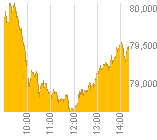
BSE Sensex
|
CNBC Live Telecast . : Finance Daily : .
Economic Times . :All Time Favorites:
Google Games
Hottest Cars-Expensive Houses
Compare your Earnings with Top Shots
. : LABLES : .
|
|||||||||||||||||||||||||||||||||||||||||||||||||||||||||||||||||||||||||||||||||||||||||||||||||||||||||||||||||||||||
Wednesday, November 26, 20087 Keys to Creating Wealth
1. They don't know how to get into the money flow. The crucial distinction between sportsmen and spectators is not that the sportsmen play and the spectators watch; it's that sportsmen get paid, while spectators pay! To get paid you need to be inside the lines, on the field of play. As long as you're the one settling debts, you're a spectator. You're investing in someone else's game. 2. They don't know how to create value. To get into the money flow means creating value, and value is created automatically when you're in your own flow, when you're doing what comes naturally to you. Warren Buffet is in his flow - buying undervalued stocks. He has an eye for spotting opportunities in great business opportunities, which he buys. He has become second richest person in the world. Donald Trump is in his flow buying and selling property. He has an eye for spotting opportunities in buildings, which he buys and sells. He has become one of the biggest property tycoons in America. 3. They don't know the difference between good debt and bad. When you buy a luxury car or a fancy electronic gadget, you're buying a liability. Any purchase that does not put cash in your pocket is a liability. Good debt buys assets that bring in cash. If you take a loan to buy an apartment building that will produce revenue, that's good debt. You can also borrow against your mortgage to acquire more assets. 4. They don't know how Rs100 saved can be turned into Rs1000 invested. When you're spending everything you earn just to survive and pay off debt, you normally think you don't have much left to save. But the truth is you don't need loads of cash to start saving, a few hundreds saved can be used to raise finance to buy an asset that will generate thousands. You can start with as little as Rs1000. 5. They don't know how to use other people's resources. Take a look at any wealthy or successful person. Are they operating alone, or do they have a team of supporters? The gung-ho, lone-ranger approach simply does not work. The first step to getting on to the field is putting the right team together. You don't have to know how to do everything, you only have to know who can do it for you.This is a key to your success.Have an asssociation with the right team of mentors,advisors, partners & workers. 6. They don't know how to control their emotions. Starting your own business is risky. So is any investment. The single most important factor is not knowledge, but being able to manage your own emotions. Most people don't invest or don't start their own business or manage an investment, not because they don't know how, but because they're afraid. which leads to errors of judgment. Emotional maturity is absolutely crucial. 7. They don't know why they want to be rich. Most people just have a vague idea that they'd like to be rich. They don't know why. They don't know what they'd do with it once they get it. If you don't have a good enough reason you should find one now. Hope you found this article useful. Labels: Business Lessons, Consulting, Stock Market  
Thursday, November 13, 2008Time value of money- a nice article
 Time value of money Do you remember our three friends - Saver, Borrower and Investor and their tryst with Inflation? Inflation is detrimental to Saver but favourable to Borrower and Investor. But this lop-sided scenario can't last forever. Saver can't always be the 'poor guy'. And Borrower and Investor can't benefit endlessly at his expense. We surely know why. If things continue as they are, then all of us would want to be borrowers and investors! And nobody would bother to save! So, the stage is set for a new character, who would balance the disequilibrium. Enter Interest, the great balancer. Interest tilts the balance in favour of our friend Saver, thereby levelling the playing field for our three friends. But how does he do that? Saver demands interest for postponing his consumption while Borrower and Investor have to pay up Interest for using Saver's surplus. Hence, what Saver loses owing to Inflation, he gains through Interest. Now that we have seen how Interest restores the balance, it is time for us to move on... Assume that your friend calls and offers you Rs10000. He says that you can have it either now or tomorrow. What would you choose? Pretty simple, eh? Your voice is loud and clear as you say, "I want now." So, why did you choose to have the Rs10000 NOW? You obviously are thinking of the many things that you can do with that money. You can buy a couple CDs or a pair of new jeans or even the pair of shoes teasingly displayed at the shoe shop on the way home. After much deliberation, you decide to go for the pair of shoes. With the cash in your pocket, all you need to do now is go to the shop and buy. However, your friend is too busy and is unable to give you the money today, but he promises that you will get it a month later. You are sorely disappointed. All your plans of buying that pair of shoes lie shattered. "Or what if somebody else buys those pair of shoes, which may well be the last such pair on earth?" "Or what if your friend delays his gift by another month?" 'If' - the root of all uncertainties! What we commonly term as 'Risk' and what can ruin all your well laid plans... Hence, if you have a choice, you would rather go to see this friend at his office and collect your money today. Why would you do that? This brings us to a fundamental truth: Time has value. We all know that the value of a rupee does not stay the same across time horizons. Due to Risk and Inflation, a rupee today is worth more than a rupee tomorrow on the time line. In simpler words, we are saying that the value of the same rupee differs at different points of time. This difference in value arises due to the passage of time. Hence, it is called the 'Time Value of Money'. Expressing this in numbers, if you believe that you can buy the same pair of shoes with Rs11000 a month later, then the time value of money for you is Rs1000for a month. Little twist in the tale Now, let us assume that your friend actually turns up and gives you Rs10000. But while on the way to the shoe shop you meet your old classmate who badly needs Rs10000. In that case, will you part with the money? You would, provided he promises to return at least Rs11000a month down the line, so that you can buy the same pair of shoes. (We know that, in real life, you would not take a penny more than what you have lent to your classmate, but just for academic purposes!) So, what do you call this extra payment that you demand over and above the amount you have lent? If the answer is 'Interest', you are right. But then what is Interest? And why is it charged? Let me explain. When you are lending the money to your friend, you forego an opportunity to buy the shoes and use them when you wanted. Hence,you would charge the cost of losing this opportunity, commonly termed as 'Opportunity Cost', to your friend in the form of Interest. One last exercise before we bid goodbye to 'Time Value of money' and 'Opportunity Cost' for now. What is the Opportunity Cost for our friends, Saver, Borrower and Investor? Saver: Saver is a lot like you. He needs to get compensated for the erosion in his purchasing power with time as also the risk associated with postponing consumption. Borrower: Now that Saver has an ace up his sleeves in the form of Interest, Borrower needs to evaluate his decision to borrow and consume now. Why? Now there is interest to contend with. Lost? If your classmate is borrowing Rs10000 from you today to meet his needs and is repaying Rs11000a month later. Then, he is better off fulfilling a need of his that will be worth at least Rs1000more a month later. Investor: Our most enigmatic friend, Investor has several opportunities knocking at his door. He can set up a beer factory or open a restaurant among other things. We could actually exhaust this page writing about the options that he has staring at him. As we all know, our clever friend hopes to maximise his profits and minimise his risks. In case he decides to set up a beer factory, the profits he would have earned by setting up a restaurant are considered as his 'Opportunity Cost'! He also has a very basic 'Opportunity Cost'. He can opt to lend his money to Borrower in return for Interest payment. Thus his investment needs to fetch him enough profits to compensate for all this. Hence, Investor needs to know the value of his future profits in today's terms for all the investment opportunities. Only then can he make the best choice. This brings us to another vital concept: 'Present Value'. source: sharekhan Labels: Business Lessons, Consulting, Excellence, Forgotten Facts, Money Making, Stock Market
Wednesday, November 12, 2008Power of Compounding
"Compound interest is the eighth wonder of the world" - Benjamin Franklin "Compound interest is the world's greatest discovery" - Albert Einstein "In case you earn Rs20,000 per month, do you know how many years it will take for you to become a Crorepati? Not 10 or 20, but 50 years!" exclaims Amitabh Bachchan, the anchor for "Kaun Banega Crorepati". Mr Bachchan, did you know that if you invest just Rs9,250 once and earn 15% per annum on this investment then, in 50 years you will be a 'Crorepati' too! And in case you invest Rs20,000 every month for 50 years under similar terms, you will be worth more than (hold your breath) Rs173cr! That is Crorepati 173 times over!!! Welcome to the 'Power of Compounding' One of the basic premises of investing is that your money multiplies manifold over time. And this multiplication of money is normally referred to as the "Power of Compounding". So, how does money compound? When you invest money, it earns interest (or returns, if you may). If you keep the interest invested, then it does not sit idle while only the original investment sweats it out. The interest earns interest too! And then the interest on interest earns interest again! That is the beauty of compounding. That is what made great men like Albert Einstein and Benjamin Franklin extol the virtues of 'compounding'. What does the 'Power of Compounding' mean to an investor? Ms Thrifty, Mr Realist and Ms Follower went to the same school and the same class. On her 10th birthday, Ms Thrifty's father gave her Rs100. She wisely invested the money that earned her an interest of 15% every year. Mr Realist won Rs200 as prize money when he was 16 years old. His friend, Ms Thrifty, advised him to invest his prize similarly. When Ms Follower earned her first salary at the age of 21, she salted away Rs400 in the same investment. After reaching the age of 60, all three decide to withdraw their investments. Who do you think realised the most from his/her investment? You think it's Ms Follower, right? After all, she invested four times the money that Ms Thrifty had invested. So what if she invested the money 10 years later. She did earn interest for 40 years anyway after that. But think again. Ms Thrifty makes the most out of her investment! In fact, her Rs100 is worth Rs1,08,366. On the other hand, Ms Follower's Rs400 is worth Rs93,169! It simply means that the LONGER you stay invested the MORE you make. Now you know why Ms Thrifty made more money than Mr Realist and Ms Follower. Let us try another small exercise. Let us assume Ms Thrifty, Mr Realist and Ms Follower invest Rs100 for 10 years. However, all three of them earn interest at different rates. Ms Thrifty earns 20% while Mr Realist earns 15% and Ms Follower manages a 10% interest rate. Can you work out what each one of them will have ten years hence? Ms Thrifty will have Rs619 while Mr Realist, Rs405. Ms Follower will have the least - Rs259 in ten years. Did you notice something though? While the interest rates differ by just 5%, in 10 years the worth of the original capital, Rs100 was vastly different! That is another way of understanding the 'Power of Compounding' or the power to grow exponentially. Now that we have understood the magic of compounding, it is time to take a look at an interesting rule associated with 'compounding' - the Rule of 72. The 'Rule of 72' is an easy way to find out in how many years your money will double at a given interest rate. Lost? Suppose the interest rate is 15%, then your money will double in 72/15= 4.8 years. In case, the interest rate is 20%, then the money will double in 3.6 years. Interesting rule indeed! Moral of the story: The longer you stay invested the more you make! Labels: Business Lessons, Stock Market
Sunday, October 12, 2008Bubble Burst!!
source : some distribution group When the bubble burst While some blame the greed of Wall Street investment bankers and the dangers of a totally unregulated system for the current financial crisis, what can't be denied is that lives, and lifestyles, have been suddenly changed across the social spectrum and careers built up over a lifetime have vanished in an instant. Apart from the revised $700 billion bailout plan, can the U.S. government do enough to restore confidence and assuage the trauma? The real question is: Who is going to compensate the common investors across the world who have lost their wealth in the resultant market meltdown? The bursting of the speculative bubble in the U.S. housing market has destroyed billions of dollars in investor wealth across the world, crippled the banking system, expunged close to a million jobs…and India has not been spared either. With banks failing by the day, definitely, these are uncertain times for the financial services industry. While many people who have lost their jobs are faced with permanent shrinkage of their lifestyle, others in the industry are going through the trauma of not knowing if and when their turn would come. Who is to blame? Flashback to year 2003: Rohit (name changed to protect identity), a good friend of mine and someone who was officially considered to be a genius with an IQ of 150+, graduated from one of the leading IIMs. Rohit managed to make it into the New York Headquarters of the most sought after firm that had arrived on campus for the first time — Lehman Brothers — a top U.S. Investment Bank (then). On joining, he was assigned to Lehman's mortgage securities desk that dealt with Collateralised Debt obligations (or CDOs). Following is an extracted transcript of a chat session I had with Rohit back in 2004: Me: So man, you must feel like you are on top of the world. Rohit: Yes dude, the job here is amazing, I get to interact with people around the world, investment managers who want to invest millions of dollars Me: Great…so tell me something interesting. What's your job all about? Rohit: You know there is a great demand for American home loans, which we buy from the U.S. banks. We then convert these into what is called as CDOs (Collateralised Debt Obligations) . In plain English, this refers to buying home loans that banks had already issued to customers, cutting them into smaller pieces, packaging the pieces based on return (interest rate), value, tenure (duration of the loans) and selling them to investors across the world after giving it a fancy name, such as "High Grade Structured Credit Enhanced Leverage Fund". Me: Wow! I would've never guessed that boring home loans could transform into something that sounds so cool! Rohit: Hahaha…actually we create multiple funds categorised based on the nature of the CDO packages they contain and investors can buy shares in any of these funds (almost like mutual funds…but called Structured Investment Vehicles or SIVs) Me: Dude, you make your job sound like a meat shop…chopping and packaging. So, in effect when an investor purchases the CDOs (or the fund containing the CDOs), he is expected to receive a share of the monthly EMI paid by the actual guys who have taken the underlying home loans? Rohit: Exactly, the banks from whom we purchased these home loans send us a monthly cheque, which we in turn distribute to the investors in our funds Me: Why do the banks sell these home loans to you guys? Rohit: Because we allow them to keep a significant portion of the interest rate charged on the home loans and we pay them upfront cash, which they can use to issue more home loans. Otherwise home loans go on for 20-30 years and it would take a long time for the bank to recover its money. Me: And, why does Lehman buy these loans? Rohit: Because we get a fat commission when we convert the loans into CDOs and sell it to investors. Me: Who are these investors? Rohit: They include everyone from pension funds in Japan to Life Insurance companies in Finland. Me: But tell me, why are these funds so interested in purchasing American home loans? Rohit: Well, these guys are typically interested in U.S. Govt. bonds (considered to be the safest in the world). But unfortunately, Mr. Alan Greenspan (head of Federal Reserve Bank, similar to RBI in India) has reduced the interest rate to nearly 1 per cent to perk up the economy after the dotcom crash 9/11attacks. This has left many funds looking for alternative investments that can give them higher returns. Home loans are ideal because they offer 4-6 per cent interest rate. Me: Wait, aren't home loans more risky than U.S Bonds? Rohit: We have made home loans less risky now. In fact they have become as safe as U.S Govt. bonds. Me: What are you saying, man? What if the people who have taken these underlying home loans default? Then the investors would stop getting the EMIs, and their returns would take a hit. Wouldn't it? Rohit: Boss, may be some will default, but not definitely more than 2-3 per cent. Moreover, we have convinced AIG (a leading insurance company) to insure our CDOs. This means that even if there were big defaults,the insurance company would compensate the investors. Me: that's amazing. What are these insurances called? Rohit: Credit Default Swaps. Me: Definitely you guys are the most creative when it comes to naming. Rohit: Thanks. Me: And why has this AIG guy insured millions of home loans? Rohit: See man, the logic is simple. Home prices in the U.S always go up. In fact over the last three years alone they have doubled. So even if someone defaults paying the EMI, the home can be seized and sold for a much higher price. So there is no risk. Insurance companies are actually competing to insure this, because they can earn risk-free premiums. Me: No wonder investment managers from all over the world want to put money in your CDOs. *A global financial cobweb started getting built around the American dream of purchasing a home and it rested on the assumption that "home prices will keep rising". As demand for the CDOs started growing across the global investment community, the investment bankers (like Lehman) who were meant to sell these instruments also started investing a significant portion of their own capital in these. I guess after selling the story to the whole world, they themselves got sold on the seemingly foolproof concept. Gradually the markets for CDOs and Credit Default Swaps started expanding with traders and investors buying and selling these as if they were shares of a company, happily forgetting the underlying people behind these products who took the home loans in the first place and on whose capacity to repay the loans, the safety of these products depended. As Wall Street firms like Lehman were churning more and more home loans into CDOs and selling them or investing their own money, there was a pressure on the banks to issue more loans so that they can be sold to the Wall Street firms in return for a commission. Slowly banks started lowering the credit quality (qualification criteria) for availing a home loan and aggressively used agents to source new loans. This slippery slope went to such an extent that in 2005, almost anyone in the U.S could buy a home worth $100,000 (45 lakhs INR) or more without income proof, without other assets, without credit history, sometimes even without a proper job. These loans were called NINA — "no income no assets". The U.S. housing market went into a classic speculative bubble. Home loans were easy to get, so more and more people were buying houses. The increased demand for houses caused the price to increase. The rising prices created even more demand, as people started to look at homes as investments — investments that never went down in value. When I touched base with my friend Rohit in late 2005, he was on cloud nine. During the previous one year, he managed to buy a home in Long Island (a posh area near New York City) worth almost a million dollars, and got himself a Mercedes. All this was interesting to hear, but what shocked me was that although he was earning close to $20,000 a month (that is what CEOs in India make) he was not able to save anything because his lifestyle expenses where growing faster than his salary. Unheeded signals In late 2006, Mortgage lenders noticed something that they'd almost never seen before. People would choose a house, sign all the mortgage papers, and then default on their very first payment. Although no one could really hear it, that was probably the moment when one of the biggest speculative bubbles in American history popped. Another factor that lead to the burst of the housing bubble was the rise in interest rates from 2004-2006. Many people had taken variable rate home loans that started getting reset to higher rates, which in turn meant higher EMIs that borrowers had not planned for. The problem was that once property values starting going down, it set off a reverse chain reaction, the opposite of what had been happening in the bubble. As more people defaulted, more houses came on the market. With no buyers, prices went even further down. In early 2007, as prices began their plunge, alarm bells started going off across mortgage-backed securities desks all over Wall Street. The people on Wall Street, like Rohit, started getting calls from investors about not getting their interest payments that were due. Wall Street firms stopped buying home loans from the local banks. This had a devastating effect on particularly the small banks and finance companies, which had borrowed money from larger banks to issue more home loans thinking they could sell these loans to Wall Street firms like Lehman and make money. Everyone got into a mad scramble to seize and sell the homes in order to get back at least some of the money. But there were just not enough buyers. The guys who had insured these loans thinking they had near zero risk (e.g. AIG) could not fulfil the unexpectedly huge number of claims. The best part was that since these insurance policies (credit default swaps) could themselves be traded, multiple people had bought and sold them, and it became so tough to even trace who was supposed to compensate for the loss. The global financial cobweb built around mortgages is on the brink of collapse. Firms, large and small, some young some as old as a 100 years have crumbled as a result of suing each other over the dwindling asset values. Lehman's India operations, that employed over a thousand staff, is up for sale and many of the employees have been asked to leave. The Indian stock market has crashed almost 50 per cent from its high (and so have markets around the world) as the Wall Street giants sold their investments in the country in an effort to salvage whatever is good in order to make up for the mortgage related loss. Hedge funds, pension funds, insurance companies all over the world have lost billions in investor's money. Many Indian B-School graduates with PPOs (pre-placement offers) in the financial sector (India and abroad) have either received an annulment or indefinite postponement of joining dates. IT firms that built and maintained software for the U.S. mortgage industry or the related Investment Banks, have shut down their business units, laid-off people or transferred them to other verticals. Fragile system For all the hoopla over the sharp and sophisticated people on Wall Street, the current financial crisis has exposed the fragility of the system. Wall Street is blaming the entire episode on people who could not repay their home loans. But the reality seems to point towards the stupidity of people who lent all this money, financial institutions that built fancy derivative packages and in effect facilitated billions in trading and investments in these fragile low quality loans. The U.S. Govt is planning to grant 700 billion dollars to the Wall Street firms to compensate the financial speculators for the money that they have lost. Isn't this like rewarding greed and stupidity? The head of a leading Investment Bank has stated, "This is necessary to sustain financial ingenuity. We don't want to spend this money on ourselves. We just want this money to go into the market so that we can carry on trading complex securities, borrowing and lending money." (Yeah…right, so that one can act as if nothing had happened without analysing too much into it). The real question is: Who is going to compensate the common investors across the world who have lost their wealth in the resultant market meltdown? (either directly or through pension funds). After being unreachable for a month now, finally I heard back from my pal, Rohit, saying he is back in India to take a break from the roller coaster ride that he had lived through. After Lehman's collapse he has lost his job and probably the house that he had bought by taking a hefty loan. I really don't know whether to feel happy for him, for getting an opportunity to learn a lesson or two from the experience or to feel sad for him for losing his job. May be I'll get a better sense of things once I meet him next week, Labels: Aig, Business Lessons, lehman brothers, Stock Market, stories
Saturday, September 06, 2008The World's Billionaires #1 Warren Buffett
 Age: 77 Fortune: self made Source: Berkshire Hathaway in United States Net Worth: $62.0 bil Country Of Citizenship: United States Residence: Omaha, Nebraska , United States, North America Industry: Investments Marital Status: widowed, remarried, 3 children Education: University of Nebraska Lincoln, Bachelor of Arts / Science Columbia University, Master of Science America's most beloved investor is now the world's richest man. Soared past friend and bridge partner Bill Gates as shares of Berkshire Hathaway climbed 25% since the middle of last July. Son of Nebraska politician delivered newspapers as a boy. Filed first tax return at age 13, claiming $35 deduction for bicycle. Studied under value investing guru Benjamin Graham at Columbia. Took over textile firm Berkshire Hathaway 1965. Today holding company invested in insurance (Geico, General Re), jewelry (Borsheim's), utilities (MidAmerican Energy), food (Dairy Queen, See's Candies). Also has noncontrolling stakes in Anheuser-Busch, Coca-Cola, Wells Fargo. Insurance operations flourished in 2007. "That party is over. It's a certainty that insurance-industry profit margins, including ours, will fall significantly in 2008." The Oracle of Omaha issued a challenge to members of The Forbes 400 in October; said he would donate $1 million to charity if the collective group of richest Americans would admit they pay less taxes, as a percentage of income, than their secretaries. Had long promised to give away his fortune posthumously. Irrevocably earmarked the majority of his Berkshire shares to charity in 2006, mostly to the Bill & Melinda Gates Foundation. Gift was valued at $31 billion on day of announcement; donation will far exceed that sum so long as Berkshire shares continue to rise. More at: Forbes Millionaires Labels: Forgotten Facts, Money Making, motivation, Stock Market
Monday, April 14, 200825 Golden Rules to stay in the stock market
1 Plan your trades. Trade your plan. 2 Keep records of your trading results. 3 Keep a positive attitude, no matter how much you lose. 4 Don't take the market home. 5 Forget your College degree and trust your instincts. 6 Successful traders buy into bad news and sell into good news. 7 Successful traders are not afraid to buy high and sell low. 8 Continually strive for patience, perseverance, determination, and rational action. 9 Limit your losses - use stops! 10 Never cancel a stop loss order after you have placed it! 11 Place the stop at the time you make your trade. 12 Never get into the market because you are anxious because of waiting. 13 Avoid getting in or out of the market too often. 14 The most difficult task in speculation is not prediction but self-control. Successful trading is difficult and frustrating. You are the most important element in the equation for success. 15 Always discipline yourself by following a pre-determined set of rules. 16 Remember that a bear market will give back in one month what a bull market has taken three months to build. 17 Don't ever allow a big winning trade to turn into a loser. Stop yourself out if the market moves against you 20% from your peak profit point. 18 Expect and accept losses gracefully. Those who brood over losses always miss the next opportunity, which more than likely will be profitable. 19 Split your profits right down the middle and never risk more than 50% of them again in the market. 20 The key to successful trading is knowing yourself and your stress point. 21 The difference between winners and losers isn't so much native ability as it is discipline exercised in avoiding mistakes. 22 Speech may be silver but silence is golden. Traders with the golden touch do not talk about their success. 23 Dream big dreams and think tall. Very few people set goals too high. A man becomes what he thinks about all day long. 24 Accept failure as a step towards victory. 25 Have you taken a loss? Forget it quickly. Have you taken a profit? Forget it even quicker! Labels: Stock Market
Saturday, March 29, 20088 KEY RATIOS FOR PICKING GOOD STOCKS
After deduction of all expenses, including taxes, the net profits of a company are split into two parts -- dividends and ploughback. Dividend is that portion of a company's profits which is distributed to its shareholders, whereas ploughback is the portion that the company retains and gets added to its reserves. The figures for ploughback and reserves of any company can be obtained by a cursory glance at its balance sheet and profit and loss account. Ploughback is important because it not only increases the reserves of a company but also provides the company with funds required for its growth and expansion. All growth companies maintain a high level of ploughback. So if you are looking for a growth company to invest in, you should examine its ploughback figures. Companies that have no intention of expanding are unlikely to plough back a large portion of their profits. Reserves constitute the accumulated retained profits of a company. It is important to compare the size of a company's reserves with the size of its equity capital. This will indicate whether the company is in a position to issue bonus shares. As a rule-of-thumb, a company whose reserves are double that of its equity capital should be in a position to make a liberal bonus issue. Retained profits also belong to the shareholders. This is why reserves are often referred to as shareholders' funds. Therefore, any addition to the reserves of a company will normally lead to a corresponding an increase in the price of your shares. The higher the reserves, the greater will be the value of your shareholding. Retained profits (ploughback) may not come to you in the form of cash, but they benefit you by pushing up the price of your shares. 2. Book value per share You will come across this term very often in investment discussions. Book value per share indicates what each share of a company is worth according to the company's books of accounts. The company's books of account maintain a record of what the company owns (assets), and what it owes to its creditors (liabilities). If you subtract the total liabilities of a company from its total assets, then what is left belongs to the shareholders, called the shareholders' funds. If you divide shareholders' funds by the total number of equity shares issued by the company, the figure that you get will be the book value per share. Book Value per share = Shareholders' funds / Total number of equity shares issued The figure for shareholders' funds can also be obtained by adding the equity capital and reserves of the company. Book value is a historical record based on the original prices at which assets of the company were originally purchased. It doesn't reflect the current market value of the company's assets. Therefore, book value per share has limited usage as a tool for evaluating the market value or price of a company's shares. It can, at best, give you a rough idea of what a company's shares should at least be worth. The market prices of shares are generally much higher than what their book values indicate. Therefore, if you come across a share whose market price is around its book value, the chances are that it is under-priced. This is one way in which the book value per share ratio can prove useful to you while assessing whether a particular share is over- or under-priced. 3. Earnings per share (EPS)EPS is a well-known and widely used investment ratio. It is calculated as: Earnings Per Share (EPS) = Profit After Tax / Total number of equity shares issued This ratio gives the earnings of a company on a per share basis. In order to get a clear idea of what this ratio signifies, let us assume that you possess 100 shares with a face value of Rs 10 each in XYZ Ltd. Suppose the earnings per share of XYZ Ltd. is Rs 6 per share and the dividend declared by it is 20 per cent, or Rs 2 per share. This means that each share of XYZ Ltd. earns Rs 6 every year, even though you receive only Rs 2 out of it as dividend. The remaining amount, Rs 4 per share, constitutes the ploughback or retained earnings. If you had bought these shares at par, it would mean a 60 per cent return on your investment, out of which you would receive 20 per cent as dividend and 40 per cent would be the ploughback. This ploughback of 40 per cent would benefit you by pushing up the market price of your shares. Ideally speaking, your shares should appreciate by 40 per cent from Rs 10 to Rs 14 per share. This illustration serves to drive home a basic investment lesson. You should evaluate your investment returns not on the basis of the dividend you receive, but on the basis of the earnings per share. Earnings per share is the true indicator of the returns on your share investments. Suppose you had bought shares in XYZ Ltd at double their face value, i.e. at Rs 20 per share. Then an EPS of Rs 6 per share would mean a 30 per cent return on your investment, of which 10 per cent (Rs 2 per share) is dividend, and 20 per cent (Rs 4 per share) the ploughback. Under ideal conditions, ploughback should push up the price of your shares by 20 per cent, i.e. from Rs 20 to 24 per share. Therefore, irrespective of what price you buy a particular company's shares at its EPS will provide you with an invaluable tool for calculating the returns on your investment. 4. Price earnings ratio (P/E) The price earnings ratio (P/E) expresses the relationship between the market price of a company's share and its earnings per share: Price/Earnings Ratio (P/E) = Price of the share / Earnings per share This ratio indicates the extent to which earnings of a share are covered by its price. If P/E is 5, it means that the price of a share is 5 times its earnings. In other words, the company's EPS remaining constant, it will take you approximately five years through dividends plus capital appreciation to recover the cost of buying the share. The lower the P/E, lesser the time it will take for you to recover your investment. P/E ratio is a reflection of the market's opinion of the earnings capacity and future business prospects of a company. Companies which enjoy the confidence of investors and have a higher market standing usually command high P/E ratios. For example, blue chip companies often have P/E ratios that are as high as 20 to 60. However, most other companies in India have P/E ratios ranging between 5 and 20. On the face of it, it would seem that companies with low P/E ratios would offer the most attractive investment opportunities. This is not always true. Companies with high current earnings but dim future prospects often have low P/E ratios. Obviously such companies are not good investments, notwithstanding their P/E ratios. As an investor your primary concern is with the future prospects of a company and not so much with its present performance. This is the main reason why companies with low current earnings but bright future prospects usually command high P/E ratios. To a great extent, the present price of a share, discounts, i.e. anticipates, its future earnings. All this may seem very perplexing to you because it leaves the basic question unanswered: How does one use the P/E ratio for making sound investment decisions? The answer lies in utilising the P/E ratio in conjunction with your assessment of the future earnings and growth prospects of a company. You have to judge the extent to which its P/E ratio reflects the company's future prospects. If it is low compared to the future prospects of a company, then the company's shares are good for investment. Therefore, even if you come across a company with a high P/E ratio of 25 or 30 don't summarily reject it because even this level of P/E ratio may actually be low if the company is poised for meteoric future growth. On the other hand, a low P/E ratio of 4 or 5 may actually be high if your assessment of the company's future indicates sharply declining sales and large losses. 5. Dividend and yield There are many investors who buy shares with the objective of earning a regular income from their investment. Their primary concern is with the amount that a company gives as dividends -- capital appreciation being only a secondary consideration. For such investors, dividends obviously play a crucial role in their investment calculations. It is illogical to draw a distinction between capital appreciation and dividends. Money is money -- it doesn't really matter whether it comes from capital appreciation or from dividends. A wise investor is primarily concerned with the total returns on his investment -- he doesn't really care whether these returns come from capital appreciation or dividends, or through varying combinations of both. In fact, investors in high tax brackets prefer to get most of their returns through long-term capital appreciation because of tax considerations. Companies that give high dividends not only have a poor growth record but often also poor future growth prospects. If a company distributes the bulk of its earnings in the form of dividends, there will not be enough ploughback for financing future growth. On the other hand, high growth companies generally have a poor dividend record. This is because such companies use only a relatively small proportion of their earnings to pay dividends. In the long run, however, high growth companies not only offer steep capital appreciation but also end up paying higher dividends. On the whole, therefore, you are likely to get much higher total returns on your investment if you invest for capital appreciation rather than for dividends. In short, it all boils down to whether you are prepared to sacrifice a part of your immediate dividend income in the expectation of greater capital appreciation and higher dividends in the years to come and the whole issue is basically a trade-off between capital appreciation and income. Investors are not really interested in dividends but in the relationship that dividends bear to the market price of the company's shares. This relationship is best expressed by the ratio called yield or dividend yield: Yield = (Dividend per share / market price per share) x 100 Yield indicates the percentage of return that you can expect by way of dividends on your investment made at the prevailing market price. The concept of yield is best clarified by the following illustration. Let us suppose you have invested Rs 2,000 in buying 100 shares of XYZ Ltd at Rs 20 per share with a face value of Rs 10 each. If XYZ announces a dividend of 20 per cent (Rs 2 per share), then you stand to get a total dividend of Rs 200. Since you bought these shares at Rs 20 per share, the yield on your investment is 10 per cent (Yield = 2/20 x 100). Thus, while the dividend was 20 per cent; but your yield is actually 10 per cent. The concept of yield is of far greater practical utility than dividends. It gives you an idea of what you are earning through dividends on the current market price of your shares. Average yield figures in India usually vary around 2 per cent of the market value of the shares. If you have a share portfolio consisting of shares belonging to a large number of both high-growth and high-dividend companies, then on an average your dividend in-come is likely to be around 2 per cent of the total market value of your portfolio. 6. Return on Capital Employed (ROCE), and 7. Return on Net Worth (RONW) While analysing a company, the most important thing you would like to know is whether the company is efficiently using the capital (shareholders' funds plus borrowed funds) entrusted to it. While valuing the efficiency and worth of companies, we need to know the return that a company is able to earn on its capital, namely its equity plus debt. A company that earns a higher return on the capital it employs is more valuable than one which earns a lower return on its capital. The tools for measuring these returns are: 1. Return on Capital Employed (ROCE), and 2. Return on Net Worth (RONW). Return on Capital Employed and Return on Net Worth (shareholders funds) are valuable financial ratios for evaluating a company's efficiency and the quality of its management. The figures for these ratios are commonly available in business magazines, annual reports and economic newspapers and financial Web sites. Return on capital employed Return on capital employed (ROCE) is best defined as operating profit divided by capital employed (net worth plus debt). The figure for operating profit is arrived at after adding back taxes paid, depreciation, extraordinary one-time expenses, and deducting extraordinary one-time income and other income (income not earned through mainline operations), to the net profit figure. The operating profit of a company is a better indicator of the profits earned by it than is the net profit. ROCE thus reflects the overall earnings performance and operational efficiency of a company's business. It is an important basic ratio that permits an investor to make inter-company comparisons. Return on net worth Return on net worth (RONW) is defined as net profit divided by net worth. It is a basic ratio that tells a shareholder what he is getting out of his investment in the company. ROCE is a better measure to get an idea of the overall profitability of the company's operations, while RONW is a better measure for judging the returns that a shareholder gets on his investment. The use of both these ratios will give you a broad picture of a company's efficiency, financial viability and its ability to earn returns on shareholders' funds and capital employed. 8. PEG ratio PEG is an important and widely used ratio for forming an estimate of the intrinsic value of a share. It tells you whether the share that you are interested in buying or selling is under-priced, fully priced or over-priced. For this you need to link the P/E ratio discussed earlier to the future growth rate of the company. This is based on the assumption that the higher the expected growth rate of the company, the higher will be the P/E ratio that the company's share commands in the market. The reverse is equally true. The P/E ratio cannot be viewed in isolation. It has to be viewed in the context of the company's future growth rate. The PEG is calculated by dividing the P/E by the forecasted growth rate in the EPS (earnings per share) of the company. As a broad rule of the thumb, a PEG value below 0.5 indicates a very attractive buying opportunity, whereas a selling opportunity emerges when the PEG crosses 1.5, or even 2 for that matter. The catch here is to accurately calculate the future growth rate of earnings (EPS) of the company. Wide and intensive reading of investment and business news and analysis, combined with experience will certainly help you to make more accurate forecasts of company earnings. Labels: Excellence, Money Making, Stock Market
Thursday, October 04, 2007The Risk of Futures Trading
Most people are naturally risk averse. They don't like to take big risks, especially financial risks. Perhaps you can relate to the point of view of humorist Will Rogers: "I am not as concerned about the return on my money as I am about the return of my money." Futures trading has the reputation of being a highly risky endeavor. It is true that a high percentage of traders eventually lose money. Many people have lost substantial sums. However, futures trading's reputation as a highly risky activity is somewhat undeserved. Think of yourself walking into your favourite gambling casino. You decide to play roulette. The table has a 5 minimum bet and a 5,000 limit, which happens to be your total risk capital. If you place a 5,000 bet on red, you should not be surprised if you immediately lost your 5,000. On the other hand, if you made only 5 bets, you could play for a long time and probably not lose very much at all. Futures trading is the same in the sense that the individual is the one who decides how he wants to operate. He can make large bets or small ones. One can trade futures carefully and risk as little as 1-2% of your trading capital on a single trade. You could trade a long time this way and not lose your entire trading capital. However, most people are not that patient. The unfortunates who lose big are those who can't control themselves. They take big risks and risk a large portion of their trading capital in an attempt to get rich quick. One important quote about trading comes from trading psychology expert Mark Douglas. As he points out, most of us are not as willing to take financial risks as we think: "Most people like to think of themselves as risk takers, but what they really want is a guaranteed outcome with some momentary suspense to make them feel as if the outcome had been in doubt. The momentary suspense adds the thrill factor necessary to keep our lives from getting too boring." Futures trader's should be fully aware of and be comfortable with the risks involved. Managing the risks of trading is a very important part of any trader's success. Although the risks can be managed, they can never be eliminated. Remember that the high returns successful speculators can earn are available only because the speculator is being paid to take risk away from others. Another thing to understand about risk in trading is that you cannot avoid losses by careful planning or brilliant strategy. Numerous losses are part of the process. In The Elements of Successful Trading, Robert Rotella puts it this way: "Trading is a business of making and losing money. Any trade, no matter how well thought out, has a chance of becoming a loser. Many people think the best traders don't lose any money and have only winning trades. This is absolutely not true. The best traders lose a lot of money, but they eventually make even more over time." There is no point trading if you cannot handle the psychological discomfort of making losing trades. While people tend to take losses personally as a sign of failure, good traders shrug them off. The best trading plans result in many losses. Because of the amount of randomness in market price action, such losses are inevitable. Labels: Forgotten Facts, Stock Market
Tuesday, September 04, 2007Be an Equity Analyst
Indian Equity analysis Labels: Stock Market
Be an Equity Analyst
Indian Equity analysis Labels: Stock Market
Thursday, November 02, 2006Best way to Invest in India-Indian stocks
Indian Economy is booming greatly. Most recently it is heard that it will grow at the rate of 10%. Resultants may be the growth in the operations and great performance showed by the Indian companies’ quarter over quarter. Stocks may be treated as one of the best investments in India from anywhere in the world. I would like to present my views on the investment strategy and the stocks View One-Sectoral View-Isn't the software sector too good to miss? Too many times, we hear that an industry, say biotechnology or software, has a bright future. That makes some investors think that they have to have a biotechnology or software stock in their portfolio. They end up buying one, regardless of what its financials are like. The future is not guaranteed for any company just because it operates in a particular industry that has a strong growth potential. It still comes down to the quality of management and how effectively the management team can direct the future of the company View 2-The magic number: 20 and no more. Once it has been decided to Invest in a stock, which brings us to the percentage of the portfolio that should be in any one stock or industry. There may not be an exact answer, but in a large portfolio, a prudent approach might be to have no more than 20% of the portfolio's total value in one single stock. As a portfolio is being built, that percentage might go as high as 25%. At the same time, I don't think there should be a formula to sell stocks just because they have performed well and exceed the said guidelines. I found the Indian stock market very interesting. A way to invest in India is to purchase Indian companies listed on US stock exchanges. Below is a list of Indian stocks listed on the US market. DR REDDY (RDY) HDFC BANK (HDB) ICICI BANK (IBN) INFOSYS TECH. (INFY) MTNL (MTE) REDIFF.COM (REDF) SATYAM COMP (SAY) SATYAM INFOWAY (SIFY) SILVERLINE TECH. (SLTTY) TATA MOTORS (TTM) VSNL (VSL) WIPRO (WIT) View3-"Don't put all your eggs in one basket." Good advice like no other. When it comes to investing, diversification - putting your money into a variety of stocks that have different return potentials and risk levels - means not putting all your eggs into one investment basket. Since market cycles vary, diversification will allow you to offset possible losses in one investment with potential gains in another and, as a result, help reduce your overall exposure to risk. So, from now on, every morning when you wake up and look in the mirror, ask yourself this: Have I diversified my portfolio today? Labels: Stock Market
Thursday, September 15, 2005Introduction to Types of Trading: Swing Traders
Scalping - The scalper is an individual who makes dozens or hundreds of trades per day, trying to "scalp" a small profit from each trade by exploiting the bid-ask spread. (You can read about scalping in Introduction to Types of Trading: Scalpers) Momentum Trading - Momentum traders look to find stocks that are moving significantly in one direction on high volume and try to jump on board to ride the momentum train to a desired profit. (You can read about momentum trading in Introduction to Types of Trading: Momentum Traders.) Technical Trading - Technical traders are obsessed with charts and graphs, watching lines on stock or index graphs for signs of convergence or divergence that might indicate buy or sell signals. (You can read about technical trading in Introduction to Types of Trading: Technical Traders.) Fundamental Trading - Fundamentalists trade companies based on fundamental analysis, which examines things like corporate events such as actual or anticipated earnings reports, stock splits, reorganizations or acquisitions. (You can read about fundamental trading in Introduction to Types of Trading: Fundamental Traders.) The Right Stock The first key to successful swing trading is picking the right stocks. The best candidates are large-cap stocks that are among the most actively traded stocks on the major exchanges: Intel, Microsoft and Cisco, for example. In an active market, these stocks will swing between broadly defined high and low extremes, and the swing trader will ride the wave in one direction for a couple of days or weeks only to switch to the opposite side of the trade when the stock reverses direction. The Right Market It should be noted that in either of the two market extremes, the bear-market environment or raging bull market, swing trading proves to be a rather different challenge than in a market that is between these two extremes. In these extremes, even the most active stocks will not exhibit the same up-and-down oscillations that they would when indexes are relatively stable for a few weeks or months. In a bear market or a raging bull market, momentum will generally carry stocks for a long period of time in one direction only, thereby confirming that the best strategy is to trade on the basis of the longer-term directional trend.The swing trader, therefore, is best positioned when markets are going nowhere - when indexes rise for a couple of days and then decline for the next few days only to repeat the same general pattern again and again. A couple of months might pass with major stocks and indexes roughly the same as their original levels, but the swing trader has had many opportunities to catch the short-term movements up and down (sometimes within a channel).Of course, the problem with both swing trading and long-term trend trading is that success is based on correctly identifying what type of market is currently being experienced. Trend trading would have been the ideal strategy for the raging bull market of the last half of the 1990s, while swing trading probably would have been best for 2000 and 2001. With the 2002 bear market, the best strategy would have been to follow the trend and short everything in sight. As economists and traders would agree, the most accurate insight into trends is viewed in retrospect. The Baseline Much research on historical data has proven that in a market conducive to swing trading liquid stocks tend to trade above and below a baseline value, which is portrayed on a chart with an exponential moving average (EMA). In his book Come Into My Trading Room: A Complete Guide to Trading, Dr. Alexander Elder uses his understanding of a stock's behavior above and below the baseline to describe the swing trader's strategy of 'buying normalcy and selling mania' or 'shorting normalcy and covering depression'. Once the swing trader has used the EMA to identify the typical baseline on the stock chart, he or she goes long at the baseline when the stock is heading up and short at the baseline when the stock is on its way down.So swing traders are not looking to hit the home run with a single trade - they are not concerned about perfect timing to buy a stock exactly at its bottom and sell exactly at its top (or vice versa). In a perfect trading environment, they wait for the stock to hit its baseline and confirm its direction before they make their moves. The story gets more complicated when a stronger uptrend or downtrend is at play: the trader may paradoxically go long when the stock jumps below its EMA and wait for the stock to go back up in an uptrend, or he or she may short a stock that has stabbed above the EMA and wait for it to drop if the longer trend is down.Taking ProfitsWhen it comes time to take profits, the swing trader will want to exit the trade as close as possible to the upper or lower channel line without being overly precise, which may cause the risk of missing the best opportunity. In a strong market when a stock is exhibiting a strong directional trend, traders can wait for the channel line to be reached before taking their profit, but in a weaker market they may take their profits before the line is hit (in the event that the direction changes and the line does not get hit on that particular swing). Conclusion Swing trading is actually one of the best trading styles for the beginning trader to get his or her feet wet, but it still offers significant profit potential for intermediate and advanced traders. Swing traders receive sufficient feedback on their trades after a couple of days to keep them motivated, but their long and short positions of several days are of the duration that does not lead to distraction. By contrast, trend trading offers greater profit potential if a trader is able to catch a major market trend of weeks or months, but few are the traders with sufficient discipline to hold a position for that period of time without getting distracted. On the other hand, trading dozens of stocks per day (day trading) may just prove too great a white-knuckle ride for some, making swing trading the perfect medium between the extremes. Labels: Stock Market
Thursday, June 02, 2005Measuring long-term performance
The take-away Only by dissecting and analyzing the underlying factors that drive earnings per share and share prices can board members, managers, and investors truly assess the long-term prospects of companies. Labels: Stock Market
Sunday, May 22, 2005Inclinations: Share Prices and Intrinsic Value
Many executives regard investor relations as a way to push share prices as high as possible and approach the task as a public-relations exercise. But the goal should really be to match the share price of a company with its intrinsic value. Excessively high share prices tend to inspire poor managerial decision making intended to prop them up, and their inevitable fall can damage employee morale. Excessively low share prices can leave a company vulnerable to takeover attempts. To avoid the drawbacks of such imbalances, executives must understand any gaps between the share price of a company and its intrinsic value, make its strategy consistent with its message to investors, explain its performance transparently, and identify its most important investors. Isn't Perfect!!!! Labels: Stock Market
Valuation:
What should a company's objective be? Simply to maximize returns for shareholders by increasing the intrinsic value of a business, or should the company acknowledge the interests of other stakeholders-employees, customers, society-in its decision making? Corporate-finance practitioners, the tumultuous recent past has reinforced two fundamental beliefs. The first is that the business of business is precisely to maximize shareholder value by increasing a business's intrinsic value. The more shareholder value a company creates in an effectively regulated market, the better the company serves all its stakeholders. The second is that maximizing value involves managing both performance in the short term and the long-term health of the company. Both requires equal insight in pre-estimation of prospects of an organisation Labels: Stock Market
|